
Nobody Talks About: Kingdom of Heaven
A Friday series of the obscure and overlooked; a quirky recommendation for the weekend...

This is the first Friday post of a series I’m going to do of some favorites of mine that that are obscure and overlooked. This will almost entirely be movies, but there will be some books - mainly about movies.
This is often my favourite kind of post I read from other people - I love the discovery aspect, even from people I disagree with and dislike… - so I hope this is useful to you.
However, half the fun of this kind of stuff is in discussion. So…
Tell me if I am crazy? Or if I am not alone. Is this old news to you? I’d like to know.
This first post is about a film that should be far better known than it is. I think it has claim to being the most overlooked big film of the past 25 years. The NYT has just done that poll and I think it should have ranked highly there. My hot take after 20 years: maybe even above Gladiator.
That said, it may actually have been disqualified because it never played theatrically in NYC - I think it played a few screenings at a theatre in LA (self funded by Scott if I remember correctly).
Kingdom of Heaven Directors Cut (2005)
Directed by Ridley Scott, Written by William Monahan
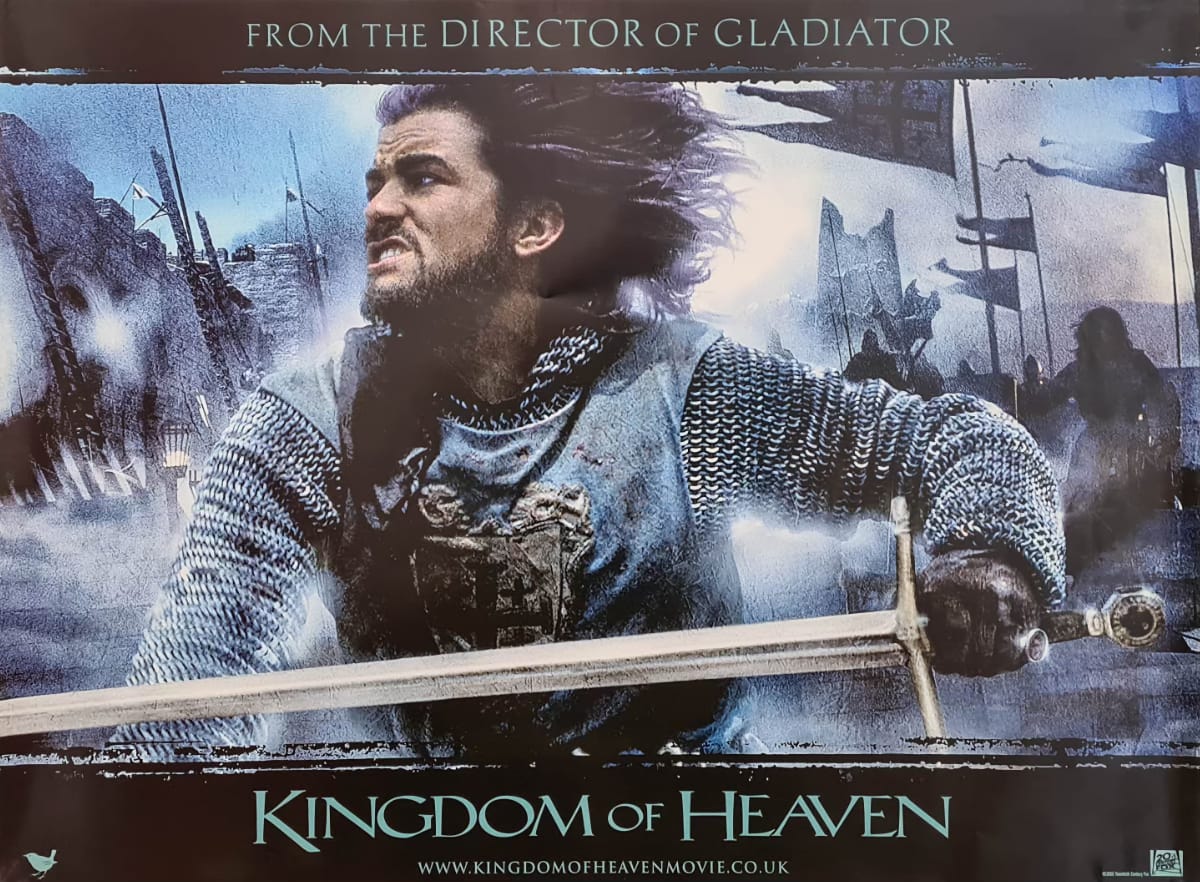
This is one of Ridley Scott's best, and most underrated movies; a beautifully written and shot film about intention and action, redemption and loss. If Blade Runner was a noir meditation on Nietzsche, then this is a medieval joust with Kant.
You may remember that the theatrical cut was a mess (if indeed, you remember this film at all). What is less known is the director's cut is not just a marketing ploy to stick in some deleted scenes but a completely different film - 40 minutes longer, one major new character and it’s actually coherent.
Orlando Bloom is a blacksmith who becomes a knight who becomes complicit in the highest level of political machinations in Jerusalem. He fights vast battles and commands a city under siege warfare.
All well and good, but the film is really about intention, action, loss and redemption. Most of all it’s a thought experiment in moral purity - which is why Bloom’s apparent naiveté is part of the design rather than “Russel Crowe would have been better.”
Scott, as shown through many of his films, has no time for moral absolutism.
And the supporting cast! Edward Norton is fantastic as the philosopher king behind a carved metal mask. Eva Green is suitably mysterious, Martin Csokas chews the scenery as if it’s his last meal while Brendan Gleeson dances around like the fascist lunatic he is.
It doesn’t quite hit the heights of Alien or Blade Runner. And this is not the place to find easy entertainment like Gladiator - but Kingdom of Heaven, to quote Videodrome, has a philosophy.