
Cinema Is Not a Shared Experience. Stop Telling Me It Is.
Going hard on film theory with an essay for those who love to sit in the front row.

A few weeks ago Ted Hope asked a question about the new Alamo Drafthouse concept in New York.
It’s a series of small screening rooms you can have dinner with friends in. I actually think it’s a good idea. But I’m not sure I was in the majority.
It reminded me of something I always found puzzling when I lived in the USA. The way every industry person would say “There will always be movie theaters, people want the shared experience in a theatre.” It never sat right for me, but I would shrug and move on.
Soon after Thomas Flight posted this, referencing McLuhan, Dario Llinares posted this (which dredged some old theory out of my unconscious), Sophie posted this last Thursday (see part 9). And of course it’s the 50th anniversary of Laura Mulvey’s Visual Pleasure essay.
Anyway.
It got me thinking.
This…
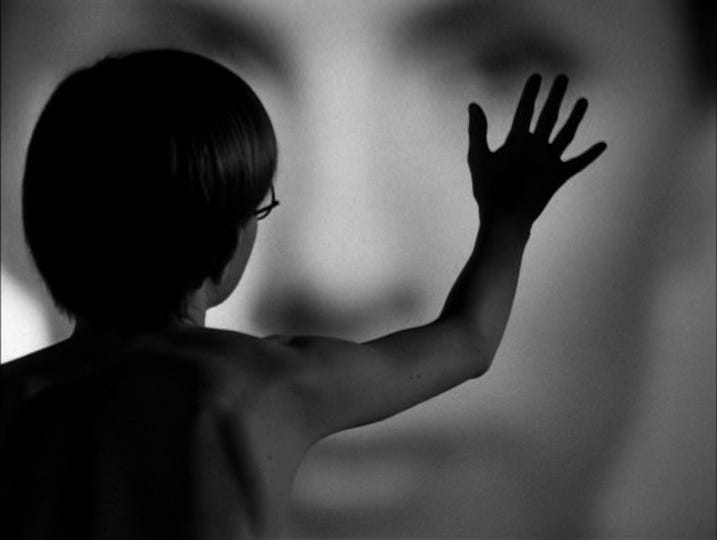
You Are Alone in the Dark
There is a fetishism - particularly in the United States - about the centrality of the shared experience of cinema in a movie theatre.
This is an illusion.
Repeating it like a mantra does not make it any more true.
The unique powers of the medium are not found in the crowd, but in the phenomenological isolation of the viewer.
Cinema has been and always will be about voyeurism.
Perhaps the most intense moment of entertainment I can recall is being stalked through the corridors of the Nostromo by the Alien.
This was not in a cinema, but virtual reality. A decade ago I spent four solid hours - no breaks - inside the Oculus DK1 fighting nausea and terror in Creative Assembly’s Alien Isolation game. Not truly designed for VR it could still be tweaked to work, but to this day I remember the intensity of hiding in the corridors, moving from shadow to shadow, listening carefully for a hint of movement, trying to find an escape.
Do I remember plot or any logical information? No. I remember an intense dream. I remember how I felt, with only flashes of imagery. VR achieves this through complete perceptual capture - total sensory monopolization that eliminates all competing inputs.
The apparatus of VR provides insights into the unique apparatus of cinema. To achieve the strongest emotional effects, the operate through the isolation of senses.
The darkened theater, the oversized image, the enforced stillness; as Jean-Louis Baudry argued these aren’t aesthetic choices, they are structural conditions of the medium. Alien Isolation played on a 2d monitor is a radically different experience from VR - it is the same source in a different medium. Even with identical moving pictures, a film on television in a bright room is not cinema.
The movie theatre contains the technical conditions required to hijack consciousness into a more receptive state. In the right circumstances, cinema deprives the mind of its natural embodied, embedded, extended, enacted reality relating systems that anchored the mind to the world.
In cognitive science, modern research in 4E approaches demonstrate that consciousness depends on a variety of interactions that distribute into the environment. Our minds actively use our bodies, environment, tools and social interactions to think and remember. The cinematic apparatus systematically hijacks the way our mind maps us to the environment.
Stillness minimizes bodily thinking, darkness cuts off environmental embedding, isolation removes social interaction and the vast screen becomes the only cognitive extension.
Recently I had the strange experience of trying to recount the plot of a film I once loved having seen it several times in a movie theater, but had not seen in some time. I completely failed to remember any plot, but I remembered it emotionally and it brought me to tears. Across the distance of time film hijacked my subconscious emotional system.
The heroes of the movies are lost friends, ones we never see but remember fondly, now they live in a place past the woods, far away beyond the hills.
Of course cinema is like a dream - this is cliche. But my recall of dreams is never as powerful as the emotions recalled from a great films. I don’t remember being situated in the theatre seeing moments of a film, I recall the emotions of the film. Cinema imprints the emotional experience as if it were a lost memory. Cinema’s most powerful operations are not social.
Every medium has its own priorities and biases. Pure cinema is a “hot medium” that dominates sensory experience on a passive viewer.
VR demonstrates the effectiveness of this strategy with brute force. It blocks alternative sensory input. Cinema and the apparatus of it more subtly achieve a similar end. The more relaxed experience of pure cinema removes interactivity and interactions that map you to the environment. You go inside the film. It makes you forget the world exists outside of the screen.
If we have a clearer understanding of the ways cinema differs from other forms of moving picture consumption then, by enhancing those unique elements, it should be easier to outline a more appropriate future for cinema distribution and exhibition at all budget levels.
Cinema should compete on the unique selling propositions of cinema as it is, rather than what it is imagined to be.
Since cinema is a capital intensive art it is often viewed through the lens of money, power and exhibition success. In addition, social inhibitions about attending the cinema solo (or indeed doing many things solo in anglophone countries) cloud the view.
A shared experience in a theatre can, counterintuitively, inhibit the functioning of great moments of cinema.
All my favourite moments of cinema are of being part of the story on screen, loving the characters and the events I’m part of. I don’t remember being in a crowd at the time.
The most enjoyable screenings I’ve attended in the giant but empty theaters of Times Square and Union Square in New York at 11pm on a Sunday. Or in London at 11am on a Wednesday.
Great cinema creates a perceptual world that approximates a dream state. It encodes the narrative experience - a symphonic-like emotional memory - in a way in which the narrative doesn’t feel watched but lived.
Apparatus theory may be considered outmoded or old fashioned, but modern cognitive science builds a solid evidentiary and theoretical infrastructure for it - certainly compared to the original psychoanalytic intuitions.
Within a modern cognitive science context, the cinematic apparatus is not about absorbing ideology passively, and it doesn’t determine meaning. The apparatus creates a specific context for a human audience member to heighten the experience of specific aesthetic effects that only cinema can achieve. This is a theory about about medium optimisation.
But none of what I write is new theory, or new insight. These are cinematic principles that would have been a given for the Nouvelle Vague.
The Medium Is the Unconscious
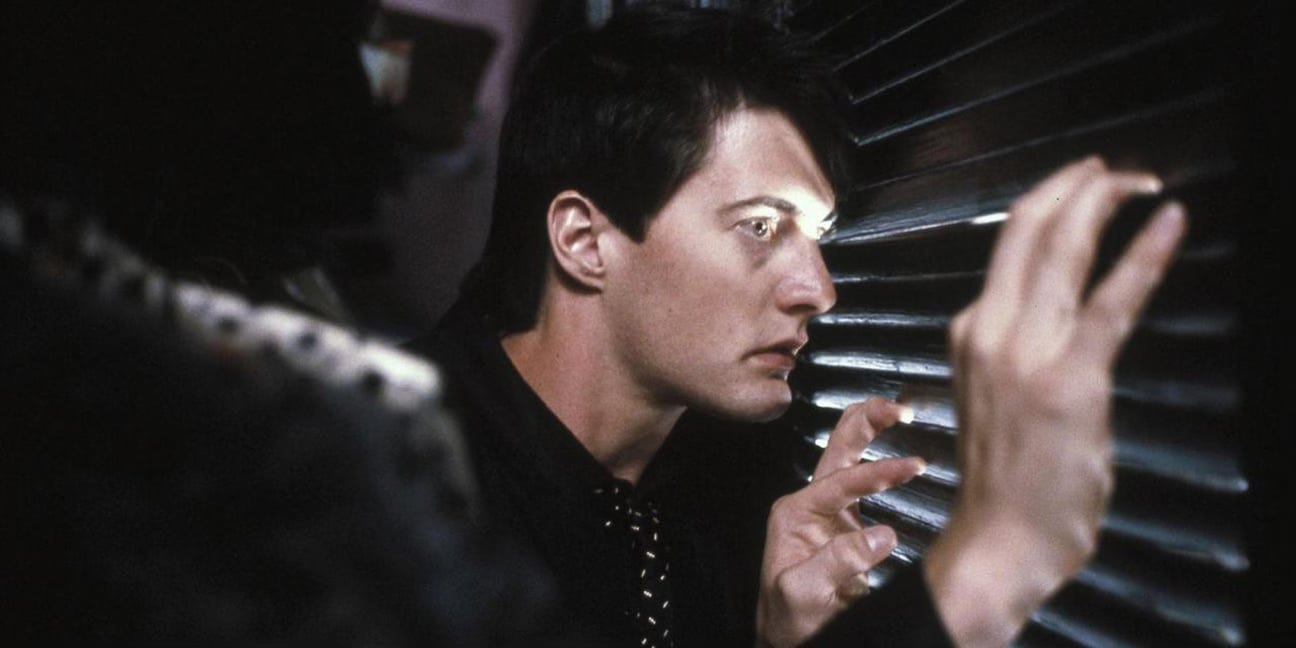
Cinema began as a peep show. A solo experience. Individual viewers, sealed viewing chambers, private encounters with moving images through Edison’s Kinetoscope and Mutoscope.
Eventually, like many things in movies, the economics changed. The peep show was scaled up into the movie theatre.
But the voyeuristic structure remains intact. We are still peering into another world, unobserved and unobservable. The picture gets bigger, the room is larger but the apparatus is the same: a fixed spectator, a framed moving image, a dark theatre, the ideal eye, the illusion of invisibility.
As Laura Mulvey famously explored, this is the foundation of why cinemas formal techniques work so effectively: we look closer, and for longer, at faces and bodies in ways you never could; except perhaps during sex; not even during sex.
This is not about the male gaze. It is about the camera that positions you where no human could stand. The editing that lets you inhabit multiple perspectives, even contradictory ones. These are techniques that depend on the viewer as an invisible observer - a ghost in the machine of the apparatus - someone watching without the possibility of being watched back. The experience is inherently pornographic.
Not in the sense of explicit content, but in its structure; the pleasure of watching without being seen. The moment you are conscious of other people, conscious of other responses, conscious of your own responses for social appropriateness - you’re pulled out of the sensory deprived voyeuristic position.
The moment you become socially aware in a theater the apparatus falters. Like sex, embarrassment is death.
The apparatus collapses.
Against Interpretation, For Experience
As Mulvey describes the camera’s voyeuristic possibilities - the access to private moments - precisely because you’re not socially present in the scene.
Ideally, situated within the apparatus a form of experience is created in line with Sontag’s conception of art with the highest value: pure sensuous immediate impact before critical interpretation.
What about someone such as Haneke who delights in reminding us we’re watching a film? A filmmaker who constantly distances the audience? All I can say is I went to see Caché five times on its first run in movie theaters and (after the first time) every time that scene happens I just stopped and watch the audience. They always jump higher in unmediated shock than any other film I know of. Haneke’s brilliance is the way he conducts the intellectual and emotional state simultaneously to manipulate the operation of the apparatus and deliver his message intellectually and emotionally - form is content.
Cinema, when the medium is exhibiting its priorities to the greatest effect, operates below the threshold of conscious analysis, embedding narrative structures directly into emotional memory. The form becomes the content.
This process is fragile.
A gasp, a laugh, a cough, a whisper, the crunch of popcorn - each element pulls you back to the room, back to normal interpersonal consciousness. The state where you’re aware of sitting near others, possibly being observed, the meta operation in your mind that concerns itself with how other see you; group dynamics disrupt private absorption.
The cinema is a machine for suspending the ego, while feeding the id.
The Destroyers of Worlds
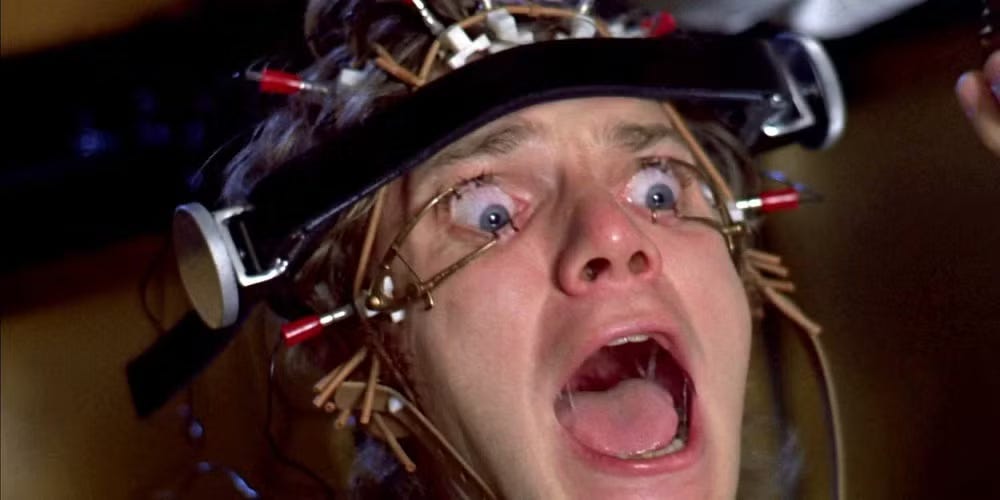
Elements that reactivate your reality-testing mechanisms degrade or destroy the unique effects of cinema.
That is: second screens, phone access, varied lighting levels, bright exit signs, chatter, anything that reminds you you’re in a building rather than the world of the moving picture.
Smell-o-vision, rumbling seats and water spray, exhibitor’s attempts at “4D” theme park rides in cinema. Entertaining as they may be, cinema they are not.
A glowing screen doesn’t distract; it shatters the sensory regression, returning you to the real world.
The big screen should be the only world.
Pure Cinema and Catalytic cinema
There are many communal viewing practices and different experiential traditions that are valid experiences. But they are different experiences, and we should separate them because they require different optimisations. When Mulvey’s fetishistic disavowal collapses, it is catalytic cinema that appears.
Pure cinema focuses on exploiting the unique biases of the medium - and requires darkness, isolation, scale and immobility.
Catalytic cinema does not sublime your unconscious into the story in the same way; you participate in a social event in a theatre that uses the cinema screen as catalyst.
To be clear, pure cinema is not inherently better or worse than catalytic cinema.
Take the analogy of an Art Museum. Galas, opening receptions, weddings, even speed dating events are all genuinely valuable and complex cultural experiences. They are also central to the value of the Art Museum as a cultural institution.
Openings, for example, are key moments in how the exhibition is received, discussed, disseminated, promoted and understood in the wider culture. This may be city specific but could influence culture across a country or the world.
However, the bias of the Art Museum as a technology is, ideally, to provide the best experience of that art. From the architectural design to the structure of experience the structures of the Art Museum are intended to facilitate interaction with art, not to find a date, however effective those structures are at providing a dating space. Dating is not the optimum aesthetic function of the Art Museum. It is not the most efficient use of the specific cultural technology.
I have had wonderful experiences dressed up throwing rice at the screen during the Rocky Horror Picture Show. In some movies I have been highly entertained by hecklers and rowdy crowds in the theater while what is on screen is a miserable example of inept storytelling.
Horror films that play the meta game of gore with a knowing audience for laughs, comedies that are amplified by communal laughter - these operate by social amplification rather than individual absorption. The shared response is part of the entertainment. A movie can be a catalyst for participation or play.
In my Caché example this was the way I experienced that moment of the film second viewing on: as catalytic cinema. I was watching aware of my surroundings, watching those in pure cinema mode, waiting for a reaction.
Certain films play both sides of this, manipulating the continuum between catalytic and pure.
Barry Lyndon - a film I recently saw in the theatre - plays more “funny” to a crowded theatre than an empty one. A few sniggers at Redmond Barry sets up a greater permission to laugh more loudly at his absurdities (and especially Leonard Rossiter in the early scenes) - and in a quieter theatre the comedy takes on a blacker sheen.
The best comedies often play this line - the subversion of expectations both in terms of on screen behavior in gags, but their subversion of the cinematic apparatus itself. The same film can operate as pure cinema or catalytic cinema depending on environmental factors. It can - and does - operate on different members of the audience in different modes.
Catalytic cinema has its own unique properties. When the cinematic apparatus is disrupted, you are re-embodied and the mechanical forms of cinema are exposed.
Unlike theatre with live actors, the screen can’t respond. This creates the opening for the audience to be loud without distracting the performance (toilet paper thrown at live stage actors is likely to get you thrown out). The crowd effects develop as they act alongside or against the screen (shared laughter and jumps). The film can be a fixed score for the audience to improvise against (heckling the screen in a horror film), or a predictable repetition that enables a ritualized response (throwing rice in Rocky Horror, singing along in Bollywood.).
Meta-cinematic activities are more accessible. This creates opportunities for a community building technology.
The issue with catalytic cinema in the twenty first century is that there are many competing cultural options that provide a similar social bonding functions. Nor are the unique elements of catalytic cinema generally recognized or appreciated as a different form of experience.
All of this at the same time that the capabilities of pure cinema are also downplayed or ignored completely by the mainstream producers and theatre owners.
The result is that theatrical cinema exhibition looses ground to competitors in other media who can offer similar or related experiences.
Television offers better serialized content, cheaper with more convenience and greater range. Social media offers more efficient community interaction with video. Live theater offers a better version of shared communal experience between performers and audience. Video games offer better immersion and challenge. Music concerts offer better group interaction.
Mainstream commercial American cinema in particular chases these markets because they look big; but the audience will continue to shrink. This is because - despite the centrality of movie making to movie people - no-one else cares about the object. Like a dream, the recall of the emotional experience after the event is the dominant element. Or to put it less theoretical, more symptomatic way: the word of mouth.
And most people “prefer to wait for it on TV".
Increasingly, films are simply bad at cinema.
Moreover, the design of films made for streaming are taking on the features of television. I have seen complaints about Netflix films redundant re-telling of plot points in dialogue, and aggressive openings to keep people interested. This is no different from the laugh track in a sitcom. It is not there to help you be part of a shared experience of television viewing (though there is an element of this as television also has a catalytic nature) - it is there to tell you this is a joke to clue you in on plot points so future jokes land. You don’t need to watch the visuals as you do something else - it is designed to be half watched in the background.
Netflix optimises for television and mobile. This is because they are in the television and mobile screen business. They don’t claim otherwise. This is why they do not release films in theaters. Ted Sarandos has said literally said this - they dabble with occasional theatrical releases for marketing reasons only. He thinks people don’t want to watch films in theaters because they have struggle to have access outside of Manhattan. There is certainly truth in this - though it is a distinctly American point of view.
It is notable that Japan, France and South Korea have far better theatrical attendance than the USA and have a tradition of far stricter in-theatre etiquette. For example, Japanese etiquette demands extreme silence (be careful in a comedy!) - and waiting till the credits are finished rolling out of respect for the filmmakers. All three also have serious local industries that make a wide range of films. They aim to make cinema. US majors have almost entirely given up on that.
Cinema is a distinct medium from television, which is a distinct medium from an iPad, which is a distinct medium from a phone.
The aesthetic priorities of the medium of cinema are distinct from the medium of television. Physical screen size and viewer situation in relation to the image is radically different. And to create the optimum emotional experience - to fully play to the aesthetic priorities of cinema...? Do I need to actually say it? The medium is the message.
The cinematic apparatus manipulates consciousness through enforced sensory isolation, the viewer becomes the ghost in the machine, the screen dominating sensory input, providing impossible views of a fantasy world.
That is the unique element of pure cinema.
The Cinematic Exhibition
What are the modern options for cinema? Most American cinemas are shockingly poor. The quality of overbuilt mass produced multiplex cinemas created endless landscape of shoeboxes with uncomfortable seats and poor viewing angles.
In the early 2000s “stadium seating” was the latest marketing trend in US exhibition upgrades. I was always puzzled coming from the UK where every cinema always had “stadium seating”.
I always sit in the front row of British cinemas. The viewing angle is good - and even at it’s worst, never as bad as in an American multiplex shoebox.
I was thrilled with recognition with one scene in The Dreamers where the cinephiles sit in the front row copying their nouvelle vague heroes. I was not alone in the dark after all.
Goddard and Truffaut would always sit in the front row when they could. Or even lie on the floor in front of the screen when the cinema was full. While I’m always in the front row if I can, I don’t have quite that commitment.
The ideal cinema presentation fills your visual field while allowing your eyes to focus at infinity. The intention is to create ideal visual conditions for maximum physical and mental relaxation. When your eyes settle into their natural resting state while the image occupies your complete visual field, your consciousness becomes more receptive.
With food service, premium recliners, pre-show entertainment - these kinds of new movie theaters can be well executed and genuinely enjoyable. It creates a broader cinematic experience that - executed well - need not necessarily inhibit the functioning of the cinematic apparatus (too much). It is about creating a superior experience that places the cinematic experience at it’s core.
Central to this is improving the experience in the room, and the services and community outside the room that extend to all parts of the viewer’s life. The room must provide isolation, but the structure of the whole experience from discovery to discussion must be focused on the inverse: community. It is futile to attempt improving cinema by disrupting the apparatus.
This is why so many multiplexes fail: they neither provide a good quality experience in the room, nor a social bonding experience outside of it.
Contrary to Baudry, the cinematic apparatus is not just about the mechanics of projection. The cinematic apparatus is about sensory capture and isolation. It functions in its peep show form - as it always has from its birth.
I remember watching (for the first time!) Kieslowski’s Three Colours: Blue on my laptop on a train. My face glued to the screen as close as I could focus - the image filling my view - headphones cutting out all other audio. There was no interruptions and nothing else in the world. That was a great cinematic experience. Perhaps not as ideal an experience as in a theatre with a similar image size on my retina with less eye and ear strain - for the apparatus functions at its peak when you are isolated from the world with minimum discomfort.
If you watch a film at home, the television is rarely more than a small portion of the image on your retina. No matter how big your television is (unless you sit unreasonably close), you will never get the real functioning of the apparatus. If you have a projector that gives you a 3 meter wide screen at home - that is something else. Usually though, the television is surrounded by distractions - visual and domestic - the temptations of choice in the real world.
You literally look down on television and look up to cinema.
Medium Specificity vs. Content Distribution
The core element of the moving image on screen (separate from the situation of the viewer) depends on the manipulation of time. But the experience of time in moving picture is problematic if you are not in the dark unable to move.
Wim Wenders’ recent film Perfect Days is not a film for television. Despite having the most mundane possible story, about the smallest of moments, it is deeply cinematic and demands to be seen on a large screen in a dark cinema. The Assassination of Jesse James by the Coward Robert Ford is similar. It is intensely slow burning, to the point that even in the cinema you may struggle to not be distracted. Tarkovsky’s films like Stalker, Solaris and Nostalgia work far better in a quiet, dark room with no distractions. You must experience the flowing manipulation of time to get the effect. If you are distracted by something upstairs, or outside the window or in the kitchen the effect is not going to work.
Television assumes interruption. I have already mentioned the primary use of a laugh track in TV comedy. Television and small screen streaming shifts the viewing of the distracted to the distraction of FOMO. For every minute you watch there could be something better - there must be something better because there is so much. “How can this be the best thing to watch out of all that content on offer?”
The experience of watching something on a phone multiplies this fomo with the small screen in front of an infinite possibility of content and social interaction. A constant stream of novelty is required to occupy the 60-90 seconds you might have waiting for the train or someone to turn up.
It is impossible to watch Perfect Days or Stalker on a phone and get a cinematic experience. This is probably not controversial. However, it follows that if a lack of distractions is the key to cinematic experience - then other audience members can be a problem for the cinematic experience too.
For the greatest cinematic experience exhibitors should optimize exhibition for comfort and isolation in the cinema - but convenience, hospitality, and social engagement outside.
The shared communal part of cinema is the meta experience around cinema. Cinema encourages discussion and debate, passion and excitement - the pure cinema experience is so inherently personal and intense that it acts as an excellent social catalyst. Outside the theatre.
The Apparatus and The Peep Show
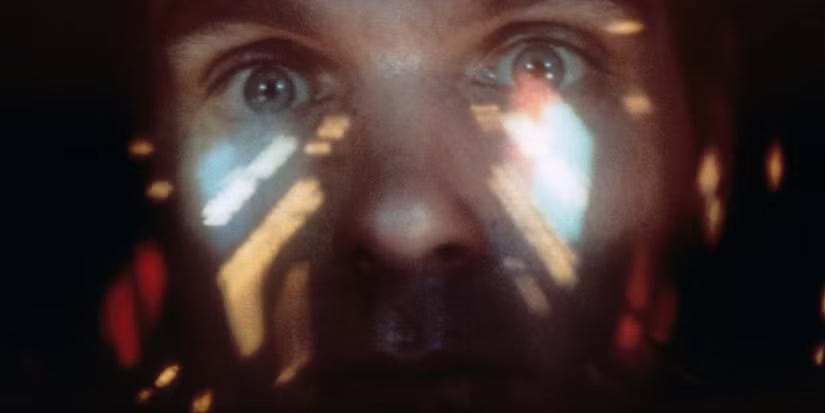
VR demonstrates the effectiveness of the isolation apparatus. In VR the difference is interactivity. Cinema in contrast requires less effort and works through viewer passivity. The “immersive” differences are a red herring. Cinema has been and always will be about voyeurism.
The medium’s unique strengths are heightened by sensory isolation. It is of course true other experiences can be had in and around the cinematic apparatus - they are not pure cinema exploiting the mediums optimum power. Catalytic cinema creates situations where the screen facilitates of communal experience - most commonly outside of the theatrical room itself.
Still, the most unique powers of the medium of cinema are not found in the shared experience in the theatre. Pure cinema’s power lies in creating temporary states of consciousness where stories feel like memories you never lived but somehow experienced.
The voyeur in the apparatus, with a disavowed secret…
The solitary voyeur can't afford the show.
Never-the-less, it has been and always will be a peep show.
Part 2 of this post: Cinemas Are A Shared Experience - Stop Making Non-Places explores exhibition spaces and the unique elements of cinema.