
Kubrick, Plot, and Six Non-Submersible Units
or How I Learned to Stop Worrying and Love Writing in Sequences

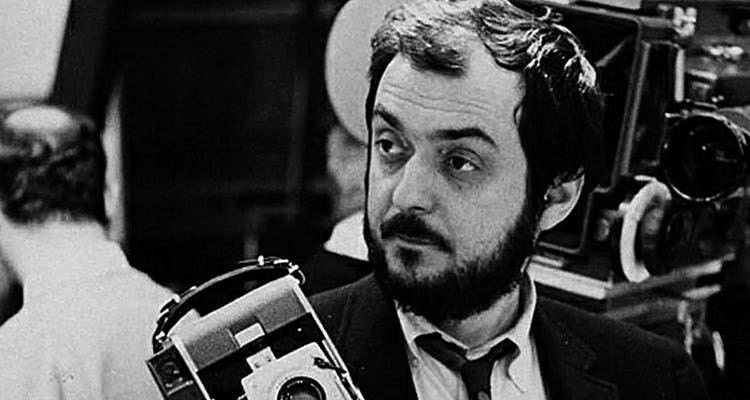
What did Kubrick mean by "Non-submersible units"?
Kubrick said you needed 6-8 in each movie.
According to Brian Aldiss: “it’s obvious!” But there multiple ways people have interpreted this…
How much did Kubrick emphasize memorable sequences over narrative plotting?
How does this relate screenwriting from the 1920s and 1930s?
The Kubrick Quote That No One Agrees On
I’m fascinated by story structures.
One phrase on structure I came across was Stanley Kurbick’s “Non-Submersible Units”. It’s often referenced by people from random Kubrick fans to other filmmakers. I searched on and off for many years trying to find out where the term was originally from and what it actually meant.
You can’t find “non-submersible unit” in reference to anything else either. It does seem to be a Kubrick neologism.
What is the metaphor about? Non-submersible is such strange phrase.
And no-one agrees on the meaning. You just get different interpretations.
Three act, five act, nine act, Kishotenketsu, Freytag’s Pyramid, Fichtean Curve; I’m curious about everything and nothing I ever found quite tracked to this non-submersible unit of Kubrick’s.
The source comes from passing advice given to Brian Aldiss by Kubrick when they were working on AI. Here are the original sources, both from Brian Aldiss interviews. This from A Life In Pictures:
I was always keen on the idea of narrative. My books always have a narrative. That is to say, cause and effect. That's what I like. But Stanley was less interested in that and he said to me “now forget about the narrative“ He said ”what you need to make a movie is six 'non-submersible units.“ That was the phrase he used: 'non-submersible units'.
And from Stanley and Us:
One of the many sensible and perceptive comments he made over the years was that a movie consists of, at most, say 60 scenes, whereas a book can have countless scenes. So, he said, it's very difficult to boil down a novel to make a film, as he found with The Shining. Much easier to take a short story and turn that into a major movie. 'All you need is six non-submersible units. Forget about the connections for the moment” ... once you've heard this, you see how 2001 was constructed.
Death of the Director: Inventing Meaning from Mystery
Unfortunately Aldiss never explicitly stated how 2001 was constructed; only that it was obvious if you look.
Originally, I took him to mean Kubrick’s own interstitial cards. This is because elsewhere Aldiss describes The Shining as constructed in this way.
So are these the 2001 non-submersible unit breaks?
Dawn of Man
Trip to the Moon
Jupiter Mission
Jupiter and Beyond the Infinite
That’s four sequences which doesn’t track with “six to eight”.
They do, however, fail to perfectly connect.
Then, Diane Johnson said about The Shining:
Next came the process of deciding on a structure, that is, which scenes, which additional scenes, and in which order. We used an eight-act structure divided roughly into timed sequences, sketched out by Kubrick: First Day, Day of the Psychiatrist; Arrival; Before the Snow things are going well; Snow (lull); Big Day (argument, radio dead, finds scrapbook, key to room 217, Lloyd, Jack to room 217 [see 216n77]); Night scene, with Sno-Cat distributor cap; last, Elevator, calls to Halloran, last twenty-four hours of terror. He saw the first four sections as lasting forty-six minutes and the rest seventy-six—which of course the film greatly exceeded.
That tracks with Kubrick thinking six to eight in a movie.
From 2001 I have also seen this breakdown:
The monolith visits humankind in its infancy
An early man discovers technology (Moon Watcher smashes the bones)
The monolith is excavated on the moon by astronauts and sends a message to Jupiter
Humankind send a manned mission to Jupiter to investigate
Advanced technology (Hal) endangers the mission crew
Technology is defeated and the surviving cremember rendezvous with the aliens
The Starchild is born
The Aldiss discussion takes place in the 1980s. Perhaps Kubrick more explicitly developed his ideas after 2001, and the success of 2001s structure informs the idea rather than exhibits it exactly.
However, Ben Wheatley, a big Kubrick fan, interpreted non-submersible units as key images or moments:
“I’m a kind of believer in the Kubrick thing about the non-submersible unit, where you look for the main images for the movie before writing the script and work backwards from that.”
That, alas, doesn’t sit well with Aldiss recounting Kubrick, or Johnson.
There is no way of knowing what Kubrick meant, only what is most productive to you.
Or is there?
Breaking the Enigma: Kubrick's Strategic Thinking
After David Lynch died, I read his biography.
In it he discusses screenwriting methods. He recommended Screenwriting: The Sequence approach by Joseph Gulino who was his teacher at the AFI.
In the 1920s screenwriting manuals instructed to work in sequences to the length of a physical reel because there was often a physical stop to change reels.
That meant stories of about 15-20 minutes. In the 30s the playwrights came in to write dialogue and they married three acts into the eight reels make a feature. So sequences would run to 8-15 minutes or there about.
At the same time I was skimming through Command and Control about nuclear weapons on submarines. All very Dr Strangelove, and it suddenly occurred to me.
Submersible.
Non-Submersible!
Kubrick was a military nerd.
It’s a naval metaphor.
He’s talking about the watertight compartments on ships and submarines. The units that lock if there is catastrophic damage to prevent the ship sinking.
He’s saying each section of story, should stand on its own. If one bit fails for the audience, the rest still floats. Sequences don’t need careful connections if they are secure internally.
Six to eight. That’s fifteen minutes per sequence for a 90-120 minute movie.
Kubrick’s talking sequences.
It’s old fashioned studio system screenwriting in military drag.
Sequence storytelling turns a 90 page problem into a series of 15 page problems. It’s far more manageable and offers particular liberation if you’re drowning in plot complexity (as Aldiss was).
This is quite different from Robert McKee, Joseph Campbell, Syd Field and so on. It’s far more productive and basic. It says, make sure your story moves along every 15 minutes.
Lawrence of Arabia is discussed at length in the Gulino book. The sequences are as follows, and each has a setup, a goal and a deadline (ticking clocks are always an easy win). And all of the driving elements can be put as a question to be answered.
Can Lawrence get out of the desert? 11.5 minutes. Yes.
Can Lawrence get to Prince Faisal with his guide? 17 minutes. Yes
Can Lawrence meet Faisal and get out in the retreat? 9 minutes. Yes
Can Lawrence figure out the Arab problem? 14 minutes. Yes
And so on. This awesome MovieWise video covers the same material:
Kubrick developed his own unique angle on sequence screenwriting. Aldiss notes that Kubrick wasn’t interested in plot, so he took the compartmentalization of sequence structure to its logical extreme.
Focus on dramatic moments, let the viewer figure out the rest. Why bother with the boring bits?
Given that context I would split 2001 into the following sequences, using the main questions drive the story through each part.
Can the monkey survive? (Dawn of Man sequence)
Yes.
Aquire technology, learn to kill.
What is happening on the moon? (The Space Station sequence)
It’s something bad.
But no reveal.
What is the Object? (The Moon sequence)
What is the Monolith?
What is the signal?!
How does Discovery work smoothly? (Discovery introduction sequence)
What do the crew do?
What happens when something fails?.
Can we fix the relay? (HAL Malfunctions sequence)
No.
HAL kills Poole.
Can Bowman defeat HAL? (Man v Machine sequence)
Is man more lethal than machine?
Yes. Bowman kills HAL.
Can Bowman Meet the Aliens? (Jupiter and Beyond the Infinite sequence)
Maybe!?
Now that doesn’t exactly track to 15 minute sequences, but 2001 is a slow film and as Diane Johnson said about The Shining, the film doesn’t necessarily end at the studio well length. It’s just a way of thinking about structure.
There is a difference between what you write and what you end up with on the screen. Nevertheless, the above is a set of relatively defined, discreet story sequences that I think any studio screenwriter would recognize.
Kubrick thought movies were more like a musical symphony. You remember and enjoy moments and scenes in the way you remember musical themes not the musical movements.
Barry Lyndon is a fascinating example. Effectively there is some setup to reach a highly dramatic scene, then a bunch of plot is skimmed over by Michael Horden’s voice over, and onto the next brief setup into another highly dramatic scene. It’s more like a series of vignettes (or movements) strung together with a voice over. It’s great.
Playing Studio Screenwriting Jenga
Gulino describes the main tools to set up and develop a sequence. These functional elements get the audience moving, and allow you to develop the dramatic moments that explore the deeper themes and interest:
Telegraphing.
You tell the audience where the story will go, and you go there. Or not. “Meet you at the Aquaba!” And you follow a few scenes to get there. Or, you fake them out and cut to the man getting arrested and you never get to the Aqaba.
Deadlines.
These ones are easy and evergreen. The bomb is ticking. We have three days to get to Vegas. The bus explodes if it goes below 30 miles an hour.
Dangling Causes.
A clear direction or an interesting question… and the answer is withheld.
This is similar to telegraphing but usually concerns character objectives. Often comes in dialogue hooks such as “I will steal the jewels!” but more subtly can also be asking interesting questions such as “Who are you?” in Lawrence of Arabia.
Dramatic Irony.
Suspense. Two characters talk, the audience knows there’s a bomb under the table. Or, in a RomCom the audience knows two characters are perfect for each other, will they realise this. Hitchcock was brilliant at layering this. Not only between audience and characters, but characters and characters.
Hitchcock gets 5 minutes of nail biting from Cary Grant waiting in an empty field in North by Northwest. Similarly, Dario Argento is a world master at shots of people walking slowly in corridors. In Susperia he constructs one of the greatest horror scenes in cinema from someone standing in an empty square with nothing around.
Dramatic Tension.
Somebody wants something badly, and they’re struggling to get it. (The Ark of The Covenant, Escape from Jurassic Park etc.)
For Mamet “Every scene must answer the questions: Who wants what from whom? What happens if they don't get it? Why now?"
But Hitchcock said, you can make any conversation interesting if you plant a bomb under the table and let the audience know it’s ticking.
That is, there are layers to narrative tension:
What happens in this scene? (the peripheral interest)
How does what is going to happen next change the trajectory of what could happen after that? (the core interest, bigger divergence means more tension)
In the context of the larger story how much do I care to see any of these things anyway? (the interest multiplier)
The level of dramatic tension in any moment arises from how much that moment is likely to alter, in an interesting way, what the audience thinks they are going to see next.
Importantly, tension is not about scale but relevance. This is why Hitchcock can get more thrills from a glass of milk than some blockbusters squeeze out of galactic annihilation. The audience are unconsciously (or consciously) calculating the odds of what happens next in terms of their interest in the story.
Kubrickian Minimlaism
Kubrick’s non-submersible units are sequences focused on these moments.
Kubrick’s push is towards minimalism. Don’t worry about connecting plot points, those can be fixed later if you have to. Strip everything else out, focus on making unbreakable dramatic units.
This is bottom up writing, and I think more helpful than the Robert McKee and Syd Field conceptions of screenplay writing that start imposing a big structure. This is much more flexible, fast and generative.
This also dovetails with Howard Hawks note that “All you need are three great scenes and no bad ones.” The implication is that you want just enough plot to let you get the maximum juice out of the dramatic moments that elucidate the theme.
My suspicion is that Kubrick was essentially telling Aldiss to relax and write the old fashioned way.
“Non-submersible units” was Kubrick’s way emphasizing the minimalism: the internal thematic drama of each sequence should be watertight. It’s more like movements in music than anything else. The sequences across the whole film barely need to connect.
If you write six 15 minute-ish sequences, then you have yourself a movie.