
HOW WOULD LUBITSCH DO IT? FilmStack Daily Inspiration #99
Steal thinking, not aesthetics: the Billy Wilder approach to inspiration (Stanley Kubrick edition)

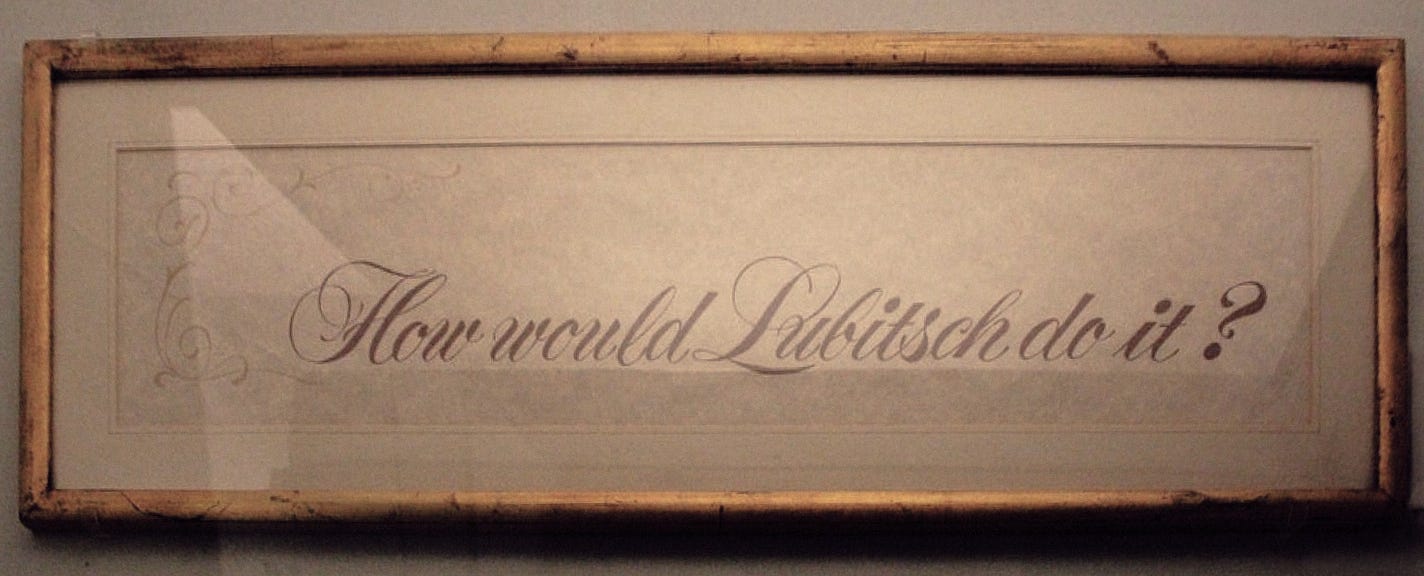
This was on the wall of Billy Wilder’s office.
How would Lubitsch do it?
It looked down on him as he made Sunset Blvd, The Apartment, Double Indemnity, Some Like It Hot and many other classics.
Wilder, generally considered by others one of the great writer/directors of all time, considered himself a student. The master was his old boss Ernst Lubitsch. Wilder was enamored of what he called the Lubitsch touch: an elegant style of visual storytelling that always slightly subverted expectations.
When Wilder got stuck he would look up to the wall for answers: How would Lubitsch write this scene? How would he film it? How would he cut it?
He didn’t ask what did Lubitsch do in that movie that I can copy. He was asking how did he come to those answers?
What is “Lubitsch Thought”?
Think like the master, and out comes the answers. Isn’t that the Wilder touch?
Adopt the mental framework.
It’s a useful intuition pump; a tool for thinking. If you understand how an artist thinks, if you’ve seen in detail how they work and function, you can use that thinking to further your own work.
I don’t know Lubitsch films so well, though I love the ones I’ve seen. Billy Wilder I know better, but I don’t know much about his production methods or his thinking.
However, I do know a bit about Stanley Kubrick.
He’s not my favourite filmmaker (that would be Kieslowski or Bergman). But for me, he is probably the most inspirational.
Kubrick documented his productions with meticulous detail. He hit on all the production problems you’re ever likely to come across. And Kubrick being Kubrick spent a lot of time coming up with clever solutions, so you don’t have to.
If you’re in London you can visit the UAL Kubrick archive and look at all the material yourself. If you just want to read the research summaries there are many fantastic books, here are a few:
Stanley Kubrick’s The Shining by J.W. Rinzler and Lee Unkrich is one of the greatest books on film making I’ve ever read. I’ve never seen a daily breakdown of events on a major film as remotely detailed as this, and it covers everything from development to release.
Eyes Wide Shut: Stanley Kubrick and the making of his final film by Kolker and Abrams
There are many others and more come out as people explore the archive.
Having a vision is usually hand waving waffle, and few bother to distinguish it from having confidence.
Specific production choices are everything.
Kubrick was forever calling random people from James Cameron to Ridley Scott to obscure novelists and musicians asking: “How did you do that?”
In military terms that Kubrick might appreciate: amateurs talk tactics, professionals talk logistics.
Think about the great filmmakers, what production choices do they make that create the aesthetic outcomes you see on screen? How do they stack the deck so success is more likely?
Do they shoot with multiple cameras? Do they shoot long takes? Wide shots? Close ups? Both? Studio or location? How many set ups? How many takes per setup? How many shots per day? Large crews? Small crews? Improvisation? Meticulous planning? Storyboarding? Shot-list? Both? None? Why? How do they construct a scene, on the page, on the set, and in the edit?
Amateurs talk tactics, professionals talk logistics.
How Would Kubrick Do It?
So what’s the most inspirational thing about Stanley Kubrick?
Fear and Desire.
It’s unwatchable.
No-one is born a genius. (And if you believe the word “genius” refers to many people other than Newton, Einstein, and maybe Beethoven, I’ve got a $750m production fund to share with you.)
Fear and Desire is permission to mess it up the first time.
But if there’s one thing to learn from Kubrick: iterate.
Kubrick was 22 when he shot Fear and Desire. He figured he could shoot without sound in the hills above LA with small crew for about 100k (today’s money). He pulled it together with intense charismatic focus and ambition.
Unfortunately, he misjudged and the post production sound killed him. It ended up costing the equivalent of about 500-600k and almost 2 years. Nor did he make all of that back. It was a bumbling amateur film exercise, written by a failed poet, crewed by a few friends and is a completely inept oddity; boring and pretentious, to use Kubrick’s own words. And yeah, that’s a pretty accurate assessment. It plays like some first year film students thinking they can make Apocalypse Now on the cheap.
If you don’t believe me, have a look. I’ll wait. It’s right here.
And here is Kubrick talking about it.
Still. He got it made. It’s not good and it lost money… but he got it made.
Make, analyse, iterate.
Killers Kiss, his next film, is a noir thriller set in a sport he was a fan of, shot on New York locations he knew, on a topic he’d already photographed for Look magazine. He managed to get a family friend to put up the 500k or so he needed because he finally got Fear and Desire into theaters. It’s nothing special, but this time, he’s on top of the photography and there are some good shots. But the story is a bit slapdash - they wrote it quickly in a few weeks to shoot action sequences locally with what they had. They shot for three months or so, four days a week (because Kubrick was picking up welfare checks on Fridays).
Take a moment to think… what family funded 500k indie film shoots for three months? Why? He’s taking forever to get the lighting right… He’s learning how do do the lighting. He even had to fire the sound guy because the boom kept getting in the way he’d set up the lights - a decision that cost him over 100k, in sound dubbing, again.
Make, analyse, iterate.
The NY Times didn’t bother to review Killer’s Kiss. It’s better that Fear and Desire but in Kubrick’s words: “still down at the level of student film making.”
This didn’t stop Stanley Hubris as he was later known in Hollywood. He was working hard on his own mythology as a genius with plenty of lurid self-generated puff pieces in print.
That’s how you get funding.
Make. Analyse. Iterate.
Killer’s Kiss, Fear and Desire and dash of PR gave him enough credibility to hook up with James Harris another young New York movie guy on the make. Now they had a deal with distributor UA and some real money backing them (Harris dad owned a very successful TV distribution company). They make the The Killing and Kubrick is hitting his stride. It’s a minor classic.
Make. Analyse. Iterate.
The next film was Paths of Glory and is legitimately one of the greatest films ever made.
Four films and 7 years.
Failing is fine, just keep an eye on the trajectory.
Of course… he was still broke, vastly in debt to James Harris, and basically hadn’t made actual money since he started with Fear and Desire. Sean Baker’s predicament is not exactly new.
What did Kubrick do?
He got so rich off Lolita he didn’t need to work again.
How he did that is another story.
The Diagnostic Question
The greatest inspiration is seeing the nuts and bolts - and especially the failures of the greats. Success looks the same from a distance, failure is where the secrets are revealed.
Take a film into DaVinci Resolve (or your preferred editor, but currently Resolve is probably the best professional editing tool - and free!). Examine the scenes, the shots, the setups. Take notes on production choices. What’s working? What’s not? Where are they flaws? Why are they there? Can you find out the crew size, the shooting schedule, the number of people on set? Look it up, in the credits - maybe even call people (it’s good networking!) How many locations? In a video editor, these things become far more obvious.
And this doesn’t apply just to film making. It applies to all art and craft.
Find the patterns. What is consistent? What are they optimising for? This is the methodology showing through. Ask why. What are they gaining from these methods? How have they structured the environment in which they work to get the outcomes they want?
Can you learn enough to estimate what they might do in a certain situation?
If Billy Wilder needed help to figure things out, then it okay for me…
How would the master get out of this situation?
How would Lubitsch do it?